






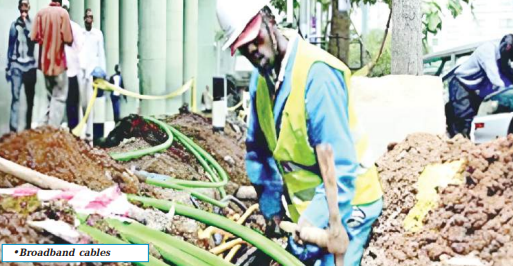
Nigeria’s broadband demand may spike by 2030,
…NCC charts spectrum roadmap to accommodate surge
By Juliet Umeh
With Nigeria’s population projected to reach 245 million by 2030, broadband demand is expected to grow significantly.
Current data trends suggest that average monthly mobile data usage could rise from 8.5 GB per subscription in 2025 to 17.7 GB by 2030, reflecting a compound annual growth rate of roughly 15.8 percent.
This surge in data consumption underscores the urgency of expanding network capacity and modernizing the country’s digital infrastructure. This is a priority highlighted in the Nigerian Communications Commission, NCC, Spectrum Roadmap for the Communications Sector (2026–2030).
Telecom growth
Nigeria’s telecommunications sector is witnessing rapid expansion. According to the latest NCC data, total active mobile subscriptions reached 182.2 million in January 2026, up from 169.3 million in January 2025. Teledensity, the number of active subscriptions per 100 inhabitants—also rose to 84.06 percent, up from 78.10 percent, signaling deeper penetration of mobile services nationwide.
Market leadership
The mobile operator landscape remains led by MTN Nigeria, with 94.2 million subscribers (51.78 percent market share), followed by Airtel Nigeria with 62.04 million users (34.09 percent), Globacom with 22.46 million (12.34 percent), and 9mobile (T2) at 3.26 million subscribers (1.79 percent).
Network technology trends show a clear shift toward faster broadband. 4G services now account for 53.41 percent of connections, up from 47.23 percent the previous year, while 5G adoption climbed to 3.94 percent from 2.54 percent. Meanwhile, 2G and 3G networks continue to decline, reflecting the country’s ongoing transition to high-speed mobile internet.
Internet subscriptions also grew steadily, reaching 151.6 million in January 2026, compared to 141.7 million in January 2025. Data usage surged to 1,385,536 terabytes, up from 1,000,930 terabytes, highlighting the increasing reliance on mobile data for work, education, entertainment, and commerce.
Extending connectivity through emerging technologies
The NCC’s roadmap emphasizes strategies to meet rising broadband demand. Direct-to-Device (D2D) satellite services are set to complement terrestrial networks, extending coverage to rural, riverine, and border areas where mobile towers cannot reach. These services also provide resilience against fibre cuts, power outages, or emergencies, while supporting new applications in IoT, smart agriculture, and public safety.
Preparing for a data-driven digital economy
Looking ahead, 4G will remain the backbone of connectivity, while 5G will expand in urban centers and enterprise environments to support latency-sensitive, data-intensive applications.
Analysts predict that even under conservative scenarios, monthly mobile data traffic could more than double by 2030, from 1,237 petabytes in 2025 to over 3,000 petabytes, emphasizing the need for expanded mid-band spectrum, improved backhaul infrastructure, and optimized spectrum utilization.
With the NCC’s strategic planning and ongoing sector investment, Nigeria is positioning itself for a robust digital economy, capable of supporting millions of subscribers and driving growth in cloud computing, AI, fintech, video streaming, and other data-intensive services.
The Spectrum Roadmap sets the stage for Nigeria to emerge as a continental leader in digital connectivity, ensuring that the country keeps pace with global technology trends while addressing the connectivity needs of all citizens.
The post Nigeria’s broadband demand may spike by 2030 appeared first on Vanguard News.
,
With Nigeria’s population projected to reach 245 million by 2030, broadband demand is expected to grow significantly.
The post Nigeria’s broadband demand may spike by 2030 appeared first on Vanguard News.
, , Nwafor, {authorlink},, , Vanguard News, March 26, 2026, 2:50 am